Google Search Console Introduces Search Generative AI Performance Reports

TL;DR
Google has announced new Search Generative AI performance reports inside Google Search Console. Designed to close a measurement gap, this update gives webmasters direct visibility into how often their content appears across Google’s generative AI ecosystem, including AI Overviews, AI Mode, and AI-powered Discover.
https://developers.google.com/search/blog/2026/06/gen-ai-performance-reports
Google’s first step in providing generative AI performance reporting
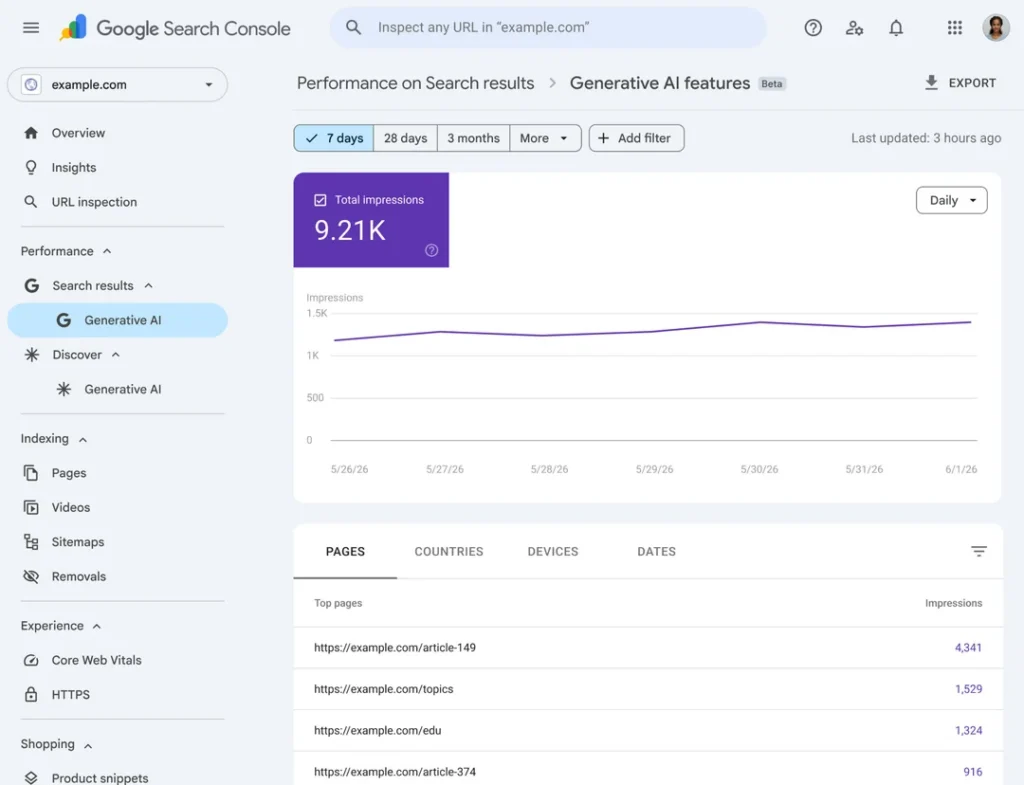
Google is introducing a separate, specialized reporting layer for generative AI search performance. Rather than guessing if traffic or impression shifts are due to standard algorithmic changes or AI Overviews, SEO professionals can now isolate and attribute AI visibility. These data will be available in their own dedicated view and inside the main performance report.
The available metrics (and what’s missing)
The report is launching with a focus on visibility, although it has some notable initial limitations:
- Available metrics: Impressions (how often URLs are served as sources in AI answers)
- Dimensions & filters: You can segment these AI impressions by specific pages (URLs), countries, devices, and dates (with granularity down to hourly, daily, weekly, or monthly views)
- What’s missing (for now): There are no click data or query-level keyword data in the initial rollout. Google has stated that additional metrics will be added over time
The timing & rollout strategy
Google is taking a phased approach to deployment rather than a sudden global launch. As stated in the announcement: “We are rolling these reports out to a subset of websites, allowing us to thoroughly test them and receive feedback before making them widely available.”
What this means for marketers and SEO professionals
- First-party generative engine optimization (GEO) data: This marks the first time marketers can track AI search performance directly within Google’s infrastructure without relying on third-party tools. With these data, teams can accurately analyze and benchmark GEO efforts, proving that Google’s conversational models actively surface and recommend the brand
- Granular URL-level auditing: In this initial view, with the pages dimension, we can instantly identify which URLs Google’s LLM deems authoritative enough to cite. SEO professionals can reverse-engineer these winning pages to find patterns in format, structure, and depth of information that Google’s AI prefers. These insights allow us to validate the current content strategy and optimize underperforming content
- A foundation for richer insights to come: While the initial release focuses strictly on top-of-funnel impressions, Google has explicitly stated that this is just the beginning, acknowledging that while data are limited for now, they plan to add additional metrics over time. This will enable marketers to build a more robust, multi-layered view of their AI performance
Looking ahead with Collective Measures
As the search landscape shifts from traditional links to AI-driven answers, navigating these changes requires agility. Collective Measures is able to adapt to this quickly evolving landscape. Through our proactive development of new optimization processes, data integrations (available natively through our proprietary analytics platform, Practix), and our tried-and-true SEO strategies, we can ensure your brand remains highly visible, measurable, and primed for sustained organic growth.